Opsarionexor
Flow Course
Flow Course
Couldn't load pickup availability
- ⬇️ Digital file available after purchase
- 🗂️ Long-term availability
- 🔒 Secure checkout
- 🗓️ Content updated in 2026
Self-paced learning overview
Share
Problem Statement
As learners take on more advanced administrative work, individual tasks begin to form continuous operational workflows. Services must be monitored, configuration changes must be reviewed, storage conditions must be checked, user activity must be managed, and system records must be interpreted together rather than as isolated subjects.
The Flow Course addresses this challenge by focusing on connected administrative routines. It helps learners build structured processes for monitoring, maintenance, troubleshooting, documentation, and follow-up review.
Solution
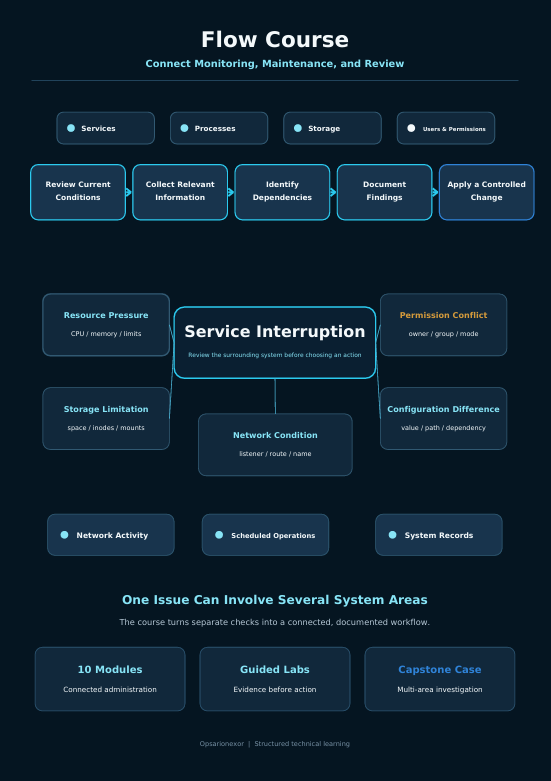
The Opsarionexor Flow Course introduces complete administrative workflows that connect system observation with planned action. Learners practise moving through a clear sequence: review the current condition, collect relevant information, identify dependencies, document findings, apply a controlled change, and verify the result.
The focus is on consistency. Each workflow uses repeatable steps that support organized technical work and reduce unnecessary changes.
What’s Inside
The Flow Course includes modules on system monitoring routines, service health review, resource analysis, process investigation, user activity management, storage maintenance, network observation, scheduled operation review, log correlation, and change verification.
Learners also work through multi-stage administrative cases where several components must be examined together. These cases encourage careful reasoning, comparison, and verification.
Who Is This For?
This course is intended for learners who already understand system services, processes, permissions, storage structures, network settings, scheduled operations, configuration files, and system records.
It is suitable for developing administrators, infrastructure support staff, technical operations learners, developers maintaining internal environments, and learners who want to organize their administrative work into clear repeatable processes.
What You’ll Learn
- Build structured daily and weekly administration routines
- Review service health and supporting dependencies
- Examine process behaviour and resource use
- Connect storage conditions with service performance
- Review user activity and permission-related concerns
- Compare network observations with reported system issues
- Correlate information from several system records
- Investigate issues across multiple technical areas
- Plan maintenance tasks in a logical order
- Document findings, changes, and follow-up actions
- Apply controlled adjustments one step at a time
- Verify system conditions after maintenance
- Create reusable troubleshooting workflows
- Organize technical notes for later review
- Separate temporary symptoms from recurring conditions
30-Day Refund Information
A refund request may be submitted within 30 days of purchase, subject to the refund terms published by the store.
The course outline provides information about the included modules, materials, technical scope, and intended learning level. Learners may review these details before purchasing and contact the Opsarionexor team with questions about the course.
Certification
The course include a certificate of completion, giving learners a clear way to confirm their progress and showcase their achievement.
Do I need previous system administration experience?
Do I need previous system administration experience?
The course collection begins with foundational concepts and gradually introduces more detailed administrative work. Earlier tiers are suitable for learners building their technical base, while later tiers explore broader infrastructure planning, troubleshooting, automation, and system maintenance.
How are the courses structured?
How are the courses structured?
Each tier is divided into focused modules containing explanations, practical examples, guided tasks, review points, and applied scenarios. The tier sequence is arranged so that each course builds on topics introduced earlier.
Are the materials suitable for self-paced learning?
Are the materials suitable for self-paced learning?
Yes. The lessons are organized for independent study. Learners can review modules in order, repeat practical tasks, and return to reference sections whenever they need additional clarification.