Opsarionexor
Vertex Guide
Vertex Guide
Couldn't load pickup availability
- ⬇️ Digital file available after purchase
- 🗂️ Long-term availability
- 🔒 Secure checkout
- 🗓️ Content updated in 2026
Self-paced learning overview
Share
Problem Statement
At this stage of system administration, learners must evaluate how several technical layers meet at a single point. Services, processes, permissions, storage, network activity, scheduled operations, and configuration records can all contribute to the same issue. A change in one area may affect several others, making isolated troubleshooting less useful.
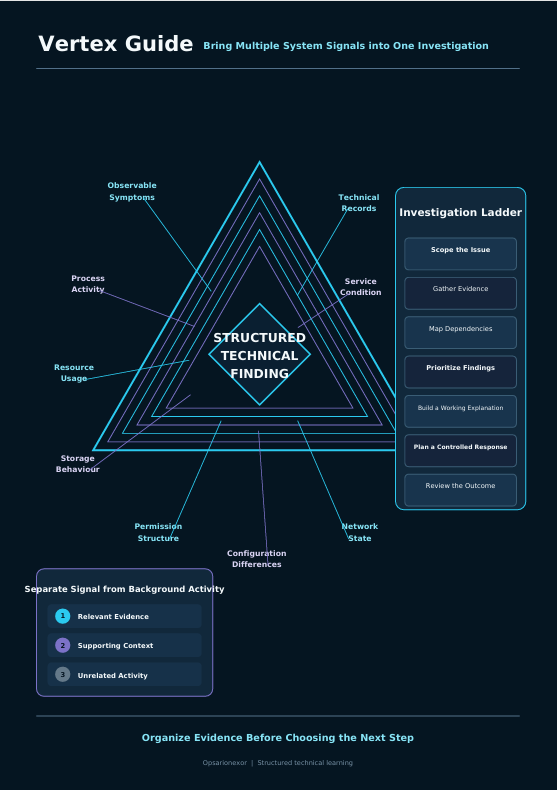
The Vertex Guide addresses these challenges by helping learners bring multiple sources of technical information together into one structured investigation.
Solution
The Opsarionexor Vertex Guide introduces methods for analysing connected system conditions and organizing detailed administrative findings. Learners practise defining the scope of an issue, mapping affected components, collecting relevant records, identifying dependencies, and arranging evidence by importance.
Attention is also given to technical decision-making. Learners prepare change plans, outline possible effects, document restoration steps, and define review criteria before modifying system settings.
What’s Inside
The Vertex Guide includes modules on incident scoping, dependency mapping, process and resource analysis, service diagnostics, storage investigation, permission review, network service inspection, scheduled operation analysis, configuration comparison, record correlation, and change planning.
The materials include investigation maps, diagnostic worksheets, technical case studies, configuration comparison tasks, dependency diagrams, maintenance checklists, documentation templates, and applied review exercises.
Who Is This For?
This course is intended for learners with a developed understanding of system services, processes, permissions, configuration files, storage, networking, scheduled operations, monitoring, and technical records.
It is suitable for system administrators, infrastructure support staff, technical operations learners, developers responsible for maintained environments, and learners who want to improve their handling of detailed system investigations.
What You’ll Learn
- Define the scope and boundaries of a system issue
- Map relationships between affected technical components
- Prioritize findings according to relevance and impact
- Analyse process activity and resource conditions
- Investigate service failures across supporting layers
- Connect storage behaviour with application and service activity
- Review permission structures during complex incidents
- Examine network services and connection states
- Correlate information from multiple technical records
- Compare current conditions with documented baselines
- Build structured hypotheses from collected evidence
- Prepare controlled change and maintenance plans
- Document possible effects before applying adjustments
- Create restoration steps for planned changes
- Define clear checks for reviewing system behaviour afterward
- Organize technical findings for future reference
30-Day Refund Information
A refund request may be submitted within 30 days of purchase, subject to the refund terms published by the store.
The course outline explains the included modules, materials, technical scope, and intended learning level. Learners may review these details before purchasing and contact the Opsarionexor team with questions about the Vertex Guide.
Certification
The course include a certificate of completion, giving learners a clear way to confirm their progress and showcase their achievement.
Do I need previous system administration experience?
Do I need previous system administration experience?
The course collection begins with foundational concepts and gradually introduces more detailed administrative work. Earlier tiers are suitable for learners building their technical base, while later tiers explore broader infrastructure planning, troubleshooting, automation, and system maintenance.
How are the courses structured?
How are the courses structured?
Each tier is divided into focused modules containing explanations, practical examples, guided tasks, review points, and applied scenarios. The tier sequence is arranged so that each course builds on topics introduced earlier.
Are the materials suitable for self-paced learning?
Are the materials suitable for self-paced learning?
Yes. The lessons are organized for independent study. Learners can review modules in order, repeat practical tasks, and return to reference sections whenever they need additional clarification.